Moir’s Series, A Posthumous Collaboration with Moir Clements, 2017-

Moir’s Pencil, Mel Day, a posthumous collaboration with Moir Clements (1924-2015), 2017, 5′ 7″, digital pigment print, graphite, gaffer tape, Photo credit: Lee Friedman

Moir’s Pencil, a posthumous collaboration, 2017, 5′ 7″ (unframed), digital pigment print, graphite, gaffer tape

Exhibition image for Love & Longing, a show I curated at Root Division in San Francisco, CA.
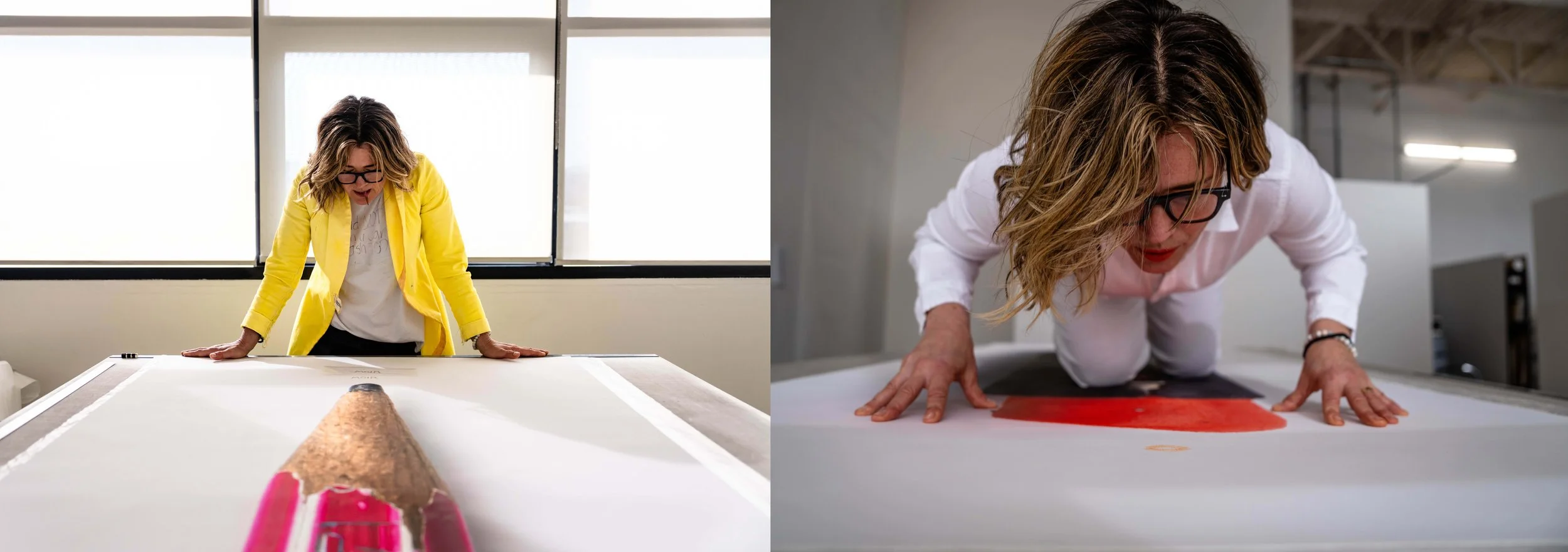
Moir’s Series, A Posthumous Collaboration, 2018-, Photo credit: Jingjing Liu
Moir’s Series is a posthumous collaboration with my grandmother (Nan), Moir Clements (1924-2015). She was a British artist, a Warden in London during World War II, and my grandmother. She painted scenes from all parts of the British Isles, always in oil paint, and often from the front of her motor caravan. Early in her career she became discouraged after her work was repeatedly rejected from exhibitions. She never felt justified calling herself an artist, and, indeed, developed an acerbic disdain for the contemporary British art establishment.
Alongside personal and artistic insecurities and longings (she lost both parents at a young age), her greatest loss was her failing sight. Moir, as she liked to be called, collaborated with her grandson, my cousin Laurence Upton, to create a series of paintings. He painted them, according to her verbal instructions and visual memory—using yellow heavily as the color she could see most clearly. At Root Division, lying by one of these collaborative paintings is a photograph of Moir’s worn-down fuchsia Staedtler pencil. She was the last person to use this pencil until I used it to sign her name posthumously. She was always an artist and is deeply loved.
Following “Moir’s Pencil” in 2017, I created the second work in this series, “Moir’s Lipstick” in 2022. I was inspired by my conversation with performance theorist and feminist scholar, Peggy Phelan for Danish artist Nanna Lysholt Hanson’s Dura Mater book, published by RSS Press. The photograph of Moir’s 50ish year old worn down orange lipstick was also printed to her height. She was the last person to use this lipstick until I used it to kiss the tip of the work.
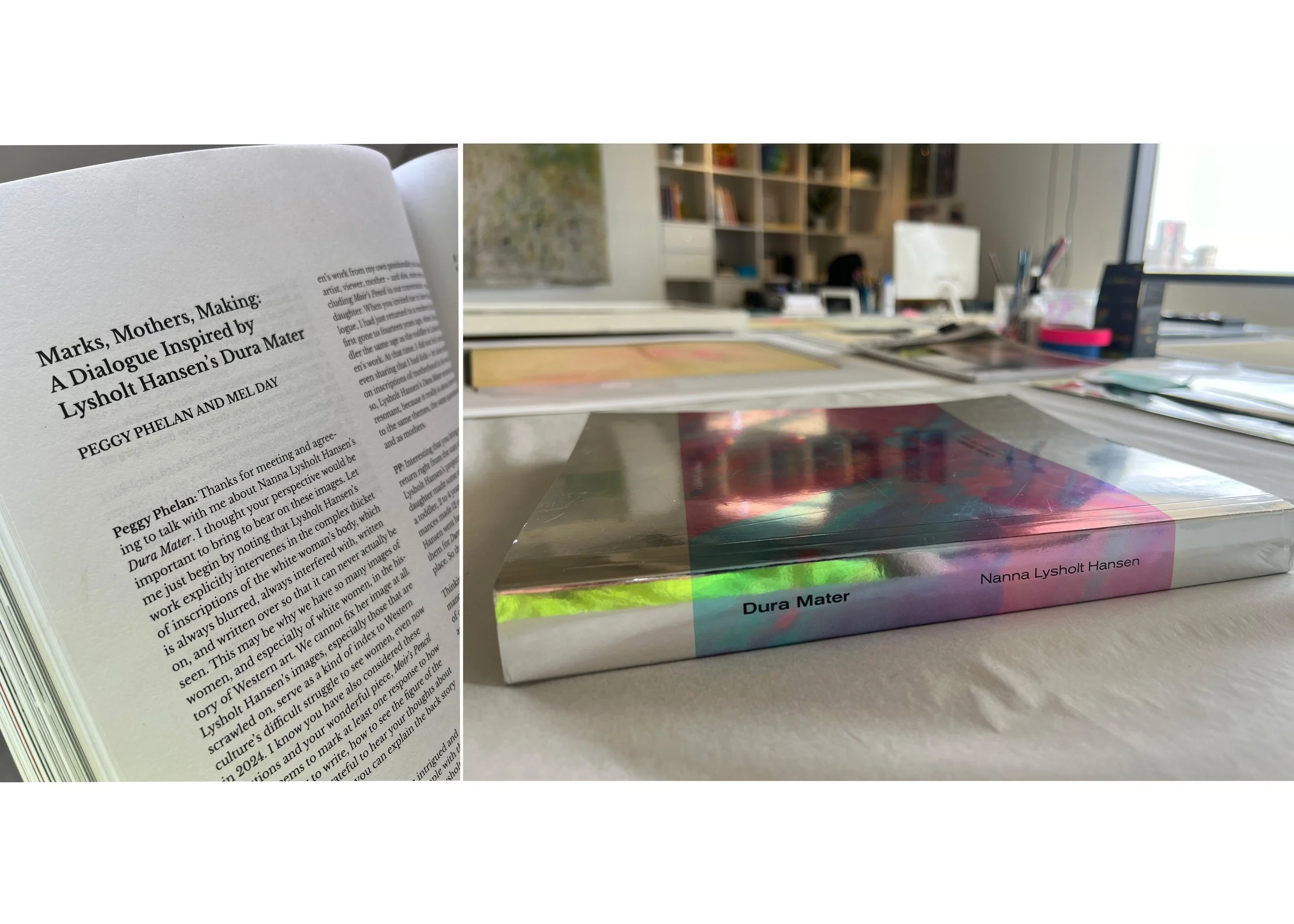
“Marks, Mothers, Making: A Dialogue Inspired by Lysholt Hansen’s Dura Mater by Peggy Phelan and Mel Day was published by RSS Press as part of Danish artist Nanna Lysholt Hanson’s Dura Mater book.
Dura Mater – Nanna Lysholt Hansen
304 pages, 24 x 28 cm, RSS Press, 2025
470 full colour images
Texts in English and Danish
The Dura Mater series is based on an extensive archive of photographic material from Lysholt Hansen’s performance for camera practice, encompassing test prints, contact sheets, and digital or silver gelatine prints of performative studies, sketches, documentation and finished works. The series was begun spontaneously in 2016 as a collaboration between Lysholt Hansen and her then 2-3-year-old daughter, who painted and drew on the archive material. In the course of 2017 her daughter lost interest, and the series ended in 2018 with one last image. In all there are 470 photographic objects.
Dura Mater presents the series in its entirety for the first time, and accompanies it with texts by invited authors who offer possible readings and new perspectives.
Performance theorist Peggy Phelan and artist Mel Day discuss co-presence and co-creation in relation to particular images in the series.
Cultural theorist Tina Kinsella writes about photography, loss and the mother-child relationship in Freud, Barthes and Bracha L Ettinger.
Cultural theorist Irina Aristarkhova explores the critique of representation and the mother’s pleasures in relation to Dura Mater, and also incorprates Lysholt Hansen’s performance texts.
Nanna Lysholt Hansen also contributes with a performative text in which she appropriates material from a conversation with the author Kirsten Thorup about mothering and artistic practice, as well as fragments from Thorup’s, Inger Christensen’s and Luce Irigaray’s works.
Also presented is a selection of poems from Kirsten Thorup’s debut collection Inside – Outside (1967), which reflects some of the themes discussed. The poems are translated into English for the first time.
Read more about this posthumous collaboration and my research into nested, mediated works as part of an exhibition I curated at Root Division in San Francisco: LOVE AND LONGING CURATORIAL ESSAY
“Now that my ladder’s gone / I must lie down where all the ladders start / In the foul rag-and-bone shop of the heart.”
—W. B. Yeats
Nov. 4 – Dec. 2 | Root Division, San Francisco
Opening Reception: Nov. 11, 2017, 7-10pm
Gallery Hours (or by appointment): Wednesday-Saturday, 2-6pm
Love & Longing shares descents into the unknown, artistic responses that perpetuate their own kind of fulfillment—“when the dark becomes another kind of lover” (John Tarrant). Through trying circumstances, a multiplicity of entanglements, and cascading heartbreaks, the works in Love & Longing share a sensibility fraught with loss, and reactions layered over time.
The exhibition includes works that chip—or pound—away at the wall separating art and life—that challenge, complicate, intensify, confront, and grapple with engagement and connection. Drawing upon a wide range of media and conceptual strategies—from the unflinchingly serious to the deadpan, from one-on-one to participatory encounters—the art works selected visually and aurally engage with unlikely, ungraspable hope, and a call for radical empathy and deepening relationships, in our own dark time.